Guide
Premium IPTV review: how to judge what other buyers write
A premium IPTV review is worth your time only when it tells you something you cannot check for yourself: how a seller behaves on a busy evening, on a device like yours, weeks or months after the payment. This guide covers where reviews of IPTV sellers appear, the signs of a useful one, the ones to skip, how to spot a review page a seller wrote about itself, and the four checks no review can make for you. One thing to say plainly first: this site shows no customer reviews yet.
What a premium IPTV review can and cannot tell you
Reviews are a record of what happened to other people. At their best they cover the parts of a membership a sales page cannot show: whether the login came when promised, whether someone answered at eleven at night, whether the picture held on a Saturday, and what happened when the end date came round.
They cannot tell you about your own home. A glowing premium IPTV review from someone with a cable to the router and a new 4K stick says nothing about a TV two rooms away on old Wi-Fi, and an angry one may describe a line that was never quick enough. Read each review as one household’s evening, not as a verdict.
Reviews also go stale fast in this field: a review from two years ago describes a different service from the one on sale today. And the people who write are mostly the delighted and the furious; the large middle who simply watch rarely post a word.
Where reviews of IPTV sellers are posted
You will meet reviews in five kinds of place. Each has its own strengths, and each can be gamed in its own way.
Open review platforms
Websites that gather ratings for any business let anyone with an account write about a seller. They put a date on every review and usually let the business reply in public, which is valuable: the way a seller handles criticism says more than its average. They are also where batches of short, glowing reviews tend to land in a single week.
Search and map listings
The stars beside a business in search results or on a map come from people signed in to that search engine. A seller with no real address may have few of them or none. Read the newest first, and see whether the seller’s replies sound like a person or like the same paragraph pasted again and again.
Forums and discussion threads
Large discussion communities and small hobby forums are where people describe problems in detail: the device, the player, the hour it happened. The weakness is that you cannot see who is posting, and some threads fill up with sellers praising themselves under other names, or with replies offering a « better deal » by private message.
Video reviews
A video can show the menus and the channel groups on a real screen, which text cannot. Read the description for a discount code or a link to pay: a presenter who earns from each sale is closer to an advert than to a reviewer.
App-store ratings rate the player, not the seller
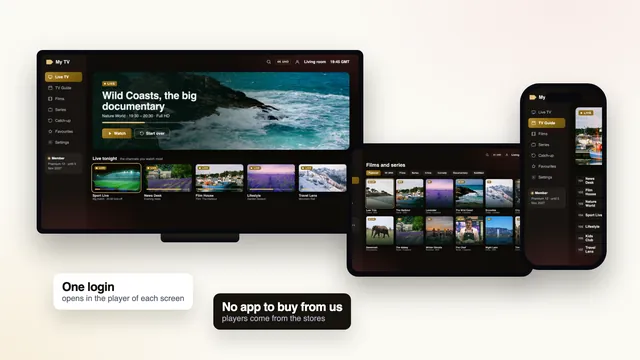
Searches for players with « premium » in their name bring up apps rated in the app stores. Those stars judge the player: its menus, its crashes, its in-app purchases. The channels come from whatever login you type in, so a well-rated player says nothing about the seller behind that login. We publish no app; the guide to the player apps that read our login explains which ones to use on each device.
| Where | Who writes | Most useful for | Watch for |
|---|---|---|---|
| Open review platforms | Anyone with an account | Dates, and the seller’s public replies | Many short reviews in one week |
| Search and map listings | Users signed in to that search engine | Recent experiences in a few lines | The same pasted reply under every review |
| Forums and discussion threads | Buyers and hobbyists, mostly anonymous | Detail: the device, the player, the time of the problem | Sellers posting as customers; « better deal » offers by private message |
| Video reviews | Channel owners | Seeing the player and its menus on a real screen | Discount codes and links that pay the presenter |
| App-store ratings | People who installed a player | The player’s menus and stability | Reading them as a verdict on any seller |
Four signs of a useful review
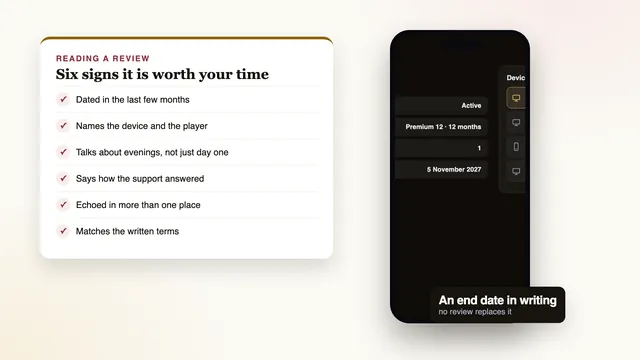
Useful reviews share four things. One review rarely has all of them, but a review with none is opinion rather than evidence.
A date, and time spent watching
A date tells you whether the review describes the service on sale now. Better still is a review written after several weeks, or one updated later. A review posted ten minutes after paying can confirm that the login arrived; it cannot say anything about the picture on a crowded night.
The device and the player
Praise means little until you know where the picture was playing. A review that names the device, the connection and the player, such as a Fire TV Stick 4K on a cable running TiviMate, or a Samsung set with Smart IPTV, lets you judge whether that household’s experience applies to your own set-up.
Evenings, not afternoons
The hours that reveal most about a seller are the evening rush, from about seven until eleven, and weekends with big matches. A reviewer who mentions football on a Saturday night or a film at nine on a weekday is telling you about the hours that matter. Daytime viewing proves much less.
Contact with the support
Did the reviewer ask something, and how long did the answer take? In what language, and did it solve the problem? Support is where sellers differ most, and it is the one part of a membership no sales page can show.
A fifth sign is rarer and worth more: what happened as the plan ended. Was a renewal pushed, or did the access simply stop on the date that had been given in writing?
Signs to skip past
- The seller’s slogans, word for word. Reviews that echo a sales page, calling the seller « number one » or promising a picture that never stops, often come straight from it.
- Bursts. A row of top marks on the same day or in the same week, after months of silence, usually follows a request or a reward rather than a sudden wave of happy viewers.
- Profiles with a single review. An account that has rated nothing else, opened that same week, carries little weight.
- No detail at all. Two words of praise could describe any seller, any month and any screen.
- The wrong product. Complaints about a box bought on an online marketplace, or praise for a player app, are not about the access.
- Anger at something never offered. A one-star review over a feature the seller never listed tells you about expectations, not about the seller.
- Replies that steer you away. A comment under a review inviting you to message a number for a cheaper login is a sales pitch at best, and often a scam.
Critical reviews deserve the same scrutiny. A detailed complaint with a date, a device and an account of how support handled it outweighs ten vague ones, and a calm, specific public reply from the seller counts in its favour.
Review pages a seller writes about itself
Among the results for a premium IPTV review you will also find pages that look independent and are not. The usual pattern is a long article styled as a ranking for the current year, published on a seller’s own website, with that same seller at the top and a buy button under every heading. The other names in the list are vague or lead nowhere.
How to recognise one
- The « review » sits on the seller’s own domain, or every button on it leads there.
- Stars or a score appear with no link to where they came from.
- Testimonials carry first names only, with no date or device, sometimes beside stock photographs.
- The date at the top moves forward every month while the text stays the same.
- Every rival has a flaw and the author has none.
None of this proves the seller is poor. It means the page is advertising and should be read as advertising. Our own guides are written by us about our own membership; they say so, they rank no one, and they review nobody, ourselves included.
Four checks no review can do for you
However good the reviews, four things can only be checked by you, in writing, before you pay anything. They take about ten minutes, and they count for more than any star score.
1. The date it stops, in writing
A plan needs a length and a stop date, written somewhere you can keep. A « lifetime » offer with no end date on paper is a warning sign, however many people praise it this month. Ours is a fixed term of 3, 12 or 24 months, paid once, and the end date is written in the welcome message that carries the login.
2. Refund days, with the cases they cover
Refund terms worth the name state how many days you have and which problems qualify. Ours give 7 days from payment, for a login message that never came or for a home where no screen shows a picture after the team’s help; second thoughts after paying are not covered. The exact terms are on the refund policy page. Without a rule, or with one that names no number, you are relying on goodwill.
3. What each month really costs
Split the price over its months. At the time of writing, offers seen online priced twelve months at £39.99 to £65, usually close to £55, while one month on its own went for £6.99 to £22. A price far below that range is a warning sign rather than a bargain. Here, Premium 12 works out at £4.08 a month and Premium 24 at £3.71; the plans page lists every monthly price and end date, and our guide to what a membership costs and what the market charges goes further.
4. A reply before you pay
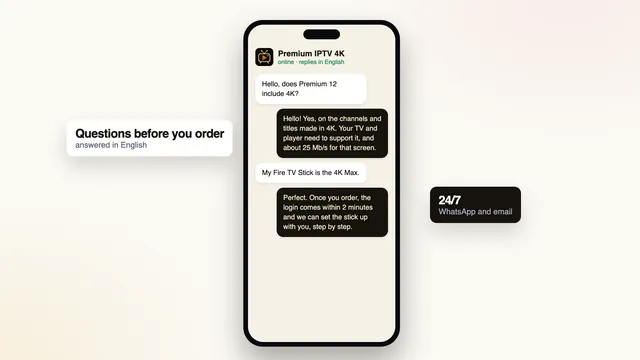
Send one question before paying, about something you can check later: which player suits your TV, what speed 4K needs, or the name your bank statement will show. Note who answers, how quickly and how clearly. Our team replies 24/7 in English on WhatsApp and by email, and questions before buying are welcome through the contact page.
| Check | A sound answer | Warning sign | Here |
|---|---|---|---|
| End date | A date in writing, sent with the login | « Lifetime », or no date anywhere | Written in the welcome message |
| Refund rule | A set number of days, and the problems it applies to | No rule, or no number | 7 days from payment, if no login or no picture despite help |
| Price per month | Inside the range seen on offers online | Far below it | £4.08 a month on Premium 12 |
| A reply before paying | A clear answer from a person | Silence until the money has gone | 24/7, in English |
| How you pay | Card or PayPal through a payment firm’s secure page | Bank transfer, gift cards or crypto only | Debit or credit card or PayPal |
Why this site shows no reviews yet
Plainly, then: there are no customer reviews on this site at the moment. We have not written any, we have not offered anyone a discount to post one, and you will find no star score or count of happy customers anywhere on these pages.
Until real reviews from members in the UK come in, there is nothing to show, and we would rather show nothing than put words in someone’s mouth.
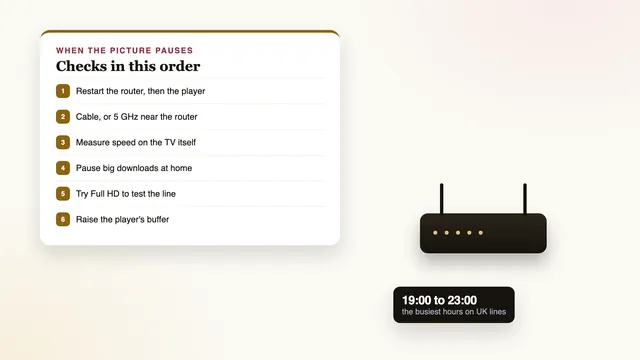
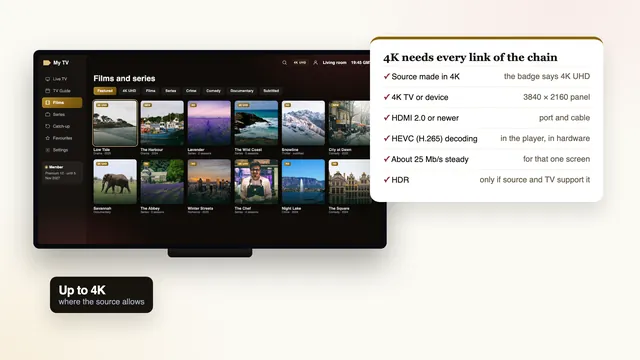
Meanwhile, most of what a review would tell you can be checked directly: the four plans with their lengths and prices, the refund rule, the setup guide from the welcome message to the first channel, and a question to the team before you pay. If pauses worry you most, our guide on why a picture pauses and what to check at home separates what depends on your home from what depends on us, and the 4K and HDR guide lists what a sharper picture needs. For the whole offer in one place, see what our premium IPTV membership includes.
If you write a review yourself
Whichever seller you use, a premium IPTV review helps the next buyer far more when it holds a few facts rather than a score. These are the details worth including:
- the date, and how long you had been watching when you wrote;
- the device, the player app, and whether it ran on a cable or on Wi-Fi;
- how the picture held in the evening and at weekends, with the speed you measured on that screen;
- any question you put to the support, how long the answer took and whether it helped;
- the plan length, and what happened as the end date came near.
Frequently asked questions
Does Premium IPTV 4K have customer reviews?
Not yet. This site shows no customer reviews, star scores or customer counts, and we have written none ourselves. Until real reviews from UK members exist, check the plans and the refund rule directly, and ask the team anything before paying.
Is a perfect average score a good sign?
Only with dates and detail behind it. A perfect score from a handful of reviews posted in the same week tells you less than a slightly lower average built up over a long time, with specific reviews and calm replies to the critical ones.
How recent should a premium IPTV review be?
Within the last few months, ideally, because a seller’s servers, apps and staff can change a great deal in a year. Read the newest critical reviews first, and look at how the seller replied to them.
Can I trust a ranking of IPTV sellers?
Find out who published it first. Many rankings sit on a seller’s own website, with that seller on top and buy buttons on every line. A ranking with no named owner, one checkout behind every link and scores with no source is advertising.
Do app-store ratings say anything about the seller?
No. They rate the player app: its menus, its stability and its in-app purchases. The channels come from the login a seller sends, and the same player can carry logins from any seller.
What should I ask a seller before paying?
Ask something you can check later: the end date of the plan, the number of refund days and what they cover, the player that suits your TV or the speed 4K needs. Notice how quickly and clearly the answer arrives. Our team replies 24/7 in English.
What should I keep out of a review I post?
Every part of the login: username, password, server address and playlist link, and screenshots that show them. Write about the device, the evenings, the support and the end date instead, which is what other buyers need.